
Introduction
How AI Is Quietly Rewriting the Rules of SEO
How AI is changing SEO starts with a simple question: When was the last time you actually clicked a Google result? Not scrolled past it — clicked it, landed on someone’s site, and actually read the page?
If you’re drawing a blank, you’re not alone.
Something has shifted in how people search, and it happened faster than most of us noticed. We’re getting answers without ever leaving the search page. And now that Google has rolled AI Overviews out to hundreds of millions of people, that shift is speeding up, not slowing down.
A few numbers make the picture vivid. SparkToro estimated that back in 2023, well over half of U.S. Google searches — around 58.5% — ended with no click at all, and that was before AI Overviews went mainstream. Various trackers throughout 2024 reported AI Overviews appearing in a significant share of search queries. Meanwhile, Perplexity — an AI-powered search engine that has grown rapidly in popularity — recorded substantial growth in search activity.
None of this is a minor trend. It’s a structural change in how people get information, and it has real consequences for anyone whose traffic depends on search.
Hi, I’m Archana, a digital marketer in Mannarkkad, passionate about helping businesses strengthen their online presence through effective digital marketing strategies. As AI continues to transform search engines, understanding how AI is changing SEO is essential for businesses and marketers who want to improve their visibility, attract the right audience, and stay competitive online.
In this article, we’ll explore how AI Overviews are changing Google search, what zero-click searches mean for website traffic, how AI search tools are influencing user behavior, and which SEO strategies can help businesses adapt. You’ll also discover practical ways to create valuable content, improve search visibility, and prepare your website for the future of AI-powered search.
So, let’s explore what’s actually changing in SEO, why some traditional SEO practices might be working against you now, and what strategies are worth using to succeed in the evolving world of AI-powered search.
What's Actually Changing in Search From "ten blue links" to an answer you never have to go looking for
For most of Google’s existence, the deal was simple: type something in, get ten links back, pick one, go read it. Not glamorous, but predictable — and predictable things are optimizable.
That model still exists. It’s just not the default experience anymore for a huge chunk of searches.
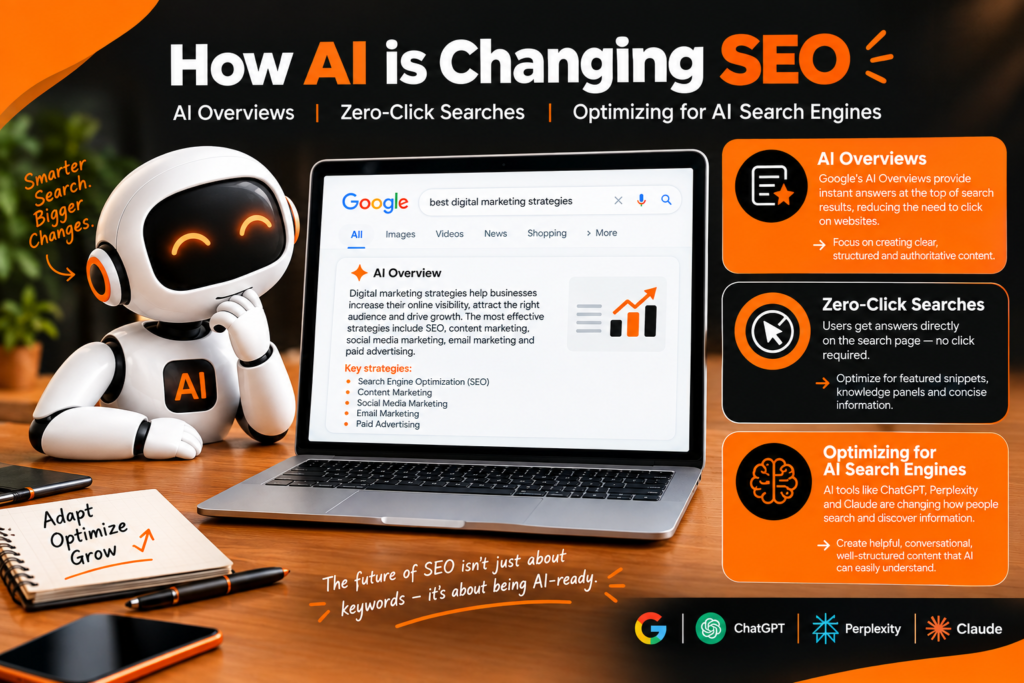
Ask Google something like “best time to post on Instagram” today, and there’s a good chance you get a full, synthesized answer sitting at the top of the page — before a single traditional link even shows up. Google calls this an AI Overview (it went by “Search Generative Experience,” or SGE, back when it was still in testing).
How AI is changing SEO is reflected in this underlying shift: search used to say “here are some pages that might help.” Now it’s increasingly saying “here’s your answer — and a few sources, if you’re curious.”
It's not just Google
Every major player in search has made some version of this move.
Google’s AI Overviews rolled out widely in May 2024 — AI-written summaries, pulled from multiple sources, sitting right at the top of results. Microsoft folded GPT-4 into Bing, turning it into something closer to a conversational assistant that can field follow-up questions and summarize on the fly. Perplexity built its whole identity around AI answers with inline citations, which has made it a favorite among researchers and people who actually want to check the sources. OpenAI added live web search directly inside ChatGPT, meaning a meaningful number of searches are now happening inside a chatbot, not a search engine at all. And both Claude and Gemini are increasingly being used to answer questions in ways that skip the traditional results page entirely.
How AI is changing SEO becomes clearer as these platforms reshape how people discover information, interact with search results, and find websites online.
The real difference
Traditional search is in the business of matching your query to relevant pages. AI search is in the business of just answering you.
Put another way: a traditional results page is a hallway of doors, and you pick the one that looks most promising. An AI-powered result tries to be the destination. That’s not a small UX tweak — it rewrites the incentives for anyone making content in hopes that search will send people their way.
The Rise of the Zero-Click Search
What it is, and why it’s exploding
A “zero-click search” is exactly what it sounds like — you search for something, get the answer right there on the results page, and never click through to any website at all.
This isn’t brand new. Featured snippets, knowledge panels, and “People Also Ask” boxes have been quietly training people toward zero-click behavior for years. But AI Overviews turned that dial up considerably. Instead of lifting one snippet from one page, Google is now stitching together information from several sources into a single, tidy, readable answer.
If you’re the one searching, this is genuinely a win — faster answers, less digging. If you’re the one whose content just got summarized, it’s a much thornier situation: your work is powering the answer, but nobody’s actually landing on your site to see it. How AI is changing SEO is evident in this shift toward zero-click searches, where users can find answers without visiting the websites that provide the information.
What it's doing to traffic
The data is still catching up to the trend, but the early signs aren’t great for publishers. Search Engine Roundtable found that some sites saw traffic on informational queries drop by 20–30% once AI Overviews became a consistent presence in their search results. How AI is changing SEO is becoming increasingly clear as publishers face new challenges in maintaining organic search traffic.